Background
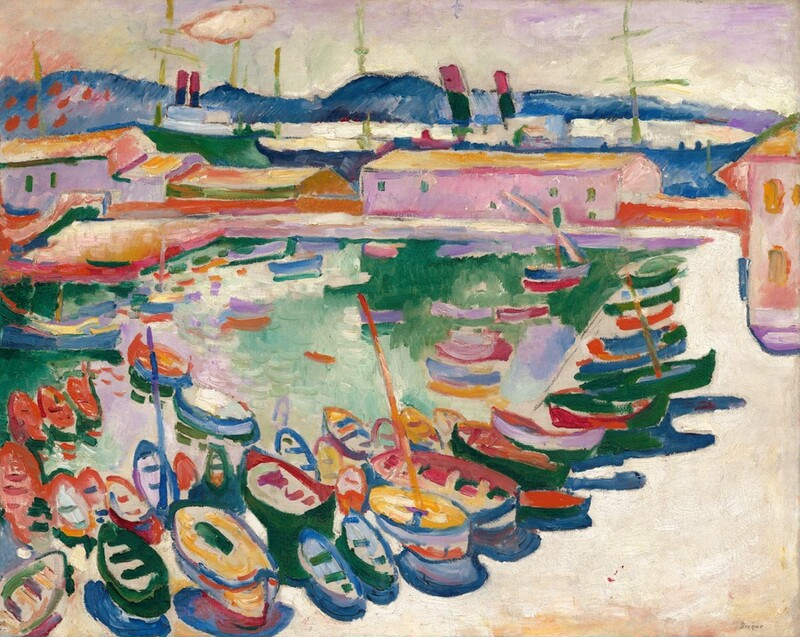
Fauvism is the name used to describe the work produced by a group of artists (which included Henri Matisse and André Derain) from around 1905 to 1910, which is characterized by unnaturalistic and strong colors and fierce, bold brushwork. The name ‘les fauves’ (the wild beasts) was coined by the critic Louis Vauxcelles when he saw the work of Henri Matisse and André Derain in an exhibition, the salon d’automne in Paris, in 1905. The paintings Derain and Matisse exhibited were the result of a summer spent working together in Collioure in the South of France and were made using bold, non-naturalistic colors (often applied directly from the tube), and wild loose dabs of paint. The forms of the subjects were also simplified making their work appear quite abstract.
Similar to Matisse and Derain, another major Fauve was Maurice de Vlaminck (1876–1958), who might be called a “natural” Fauve because his use of highly intense color corresponded to his own eccentric nature. Kees van Dongen, Charles Camoin, Henri-Charles Manguin, Othon Friesz, Jean Puy, Louis Valtat, and Georges Rouault are some of the lesser known Fauves. These were joined by Georges Braque and Raoul Duffy in 1906.
At first, the word Fauve was used as a derogatory term to refer to the group of painters who produced paintings which experimented with application of color, its position in the entire composition and its perception by the viewers. In the later period though, Fauvism and Fauvist painters gained recognition and respect for reevaluating and resetting the position and significance of color in a composition.
Fauvism was the first of the avant-garde movements that flourished in France in the early years of the twentieth century. The Fauve painters were the first to break with Impressionism as well as with older, traditional methods of perception. Their spontaneous, often subjective response to nature was expressed in bold, undisguised brushstrokes and high-keyed, vibrant colors directly from the tube. The members of this group of painters shared the use of intense color as a vehicle for describing light and space, and redefined pure color and form as means of communicating the artist’s emotional state.
Features

Maurice de Vlaminck, Paysage au bois mort (Ramasseur de bois mort), 1906, Oil on canvas, 64.5 x 80.5 cm (Sotheby’s, London)
One of the most important and revolutionary aspect of Fauvism was the Fauves’ use of color, which was unique and arbitrary. The use of unnatural and unconventional colors to represent objects, both animate and inanimate was something new to the world of western art. Though, to the untrained naked eye, the colors may seem random and at times illogical, they embodied the emotional landscapes of the painters. Above all, Fauvism valued individual expression. The artist’s direct experience of his subjects, his emotional response to nature, and his intuition were all more important than academic theory or elevated subject matter. All elements of painting were employed in service of this goal.

Henri Matisse, Open Window, Collioure, 1905, Oil on canvas, 55.3 x 46 cm (National Gallery of Art, Washington)

Maurice de Vlaminck, The River Seine At Chatou, 1906, Oil on canvas, 81.6 cm x 101 cm (The Metropolitan Museum of Art, New York City)
Fauvism can be said to have succeeded in achieving its main objective, a radical goal of separating color from its descriptive, representational purpose and allowing it to exist on the canvas as an independent element. Color could project a mood and establish a structure within the work of art without having to be true to the natural world. By emancipating color from its previous functions and roles in a composition, the Fauves gave “color” a new identity, a separate entity on the canvas. This feature is best explained by Matisse himself. He says, “When I put down a green, it doesn’t mean grass; and when I put down a blue, it doesn’t mean the sky”.
Thus, Fauvism was known for bold, vibrant, colors used in unusual juxtaposition, and an intuitive, highly gestural application of paint. The artists of Fauvism were experimenting with the ways in which color could be liberated from subject matter. They purposefully painted recognizable imagery but with surprising chromatic dissonance; a sky could be red, or a woman’s face green, allowing color to convey meaning in its own right, outside of its connection to the object depicted.

André Derain, Waterloo Bridge, 1906, Oil on canvas, 80.5 x 101 cm (Museo Nacional Thyssen-Bornemisza, Madrid)

André Derain, Charing Cross Bridge, London, 1906, Oil on canvas, 80.3 cm x 100.3 cm (National Gallery of Art, Washington)
Fauvism can be seen as an extreme extension of the post-impressionism of Van Gogh combined with the neo-impressionism of Seurat. The influences of these earlier movements inspired Matisse and his followers to reject traditional three-dimensional space and instead use flat areas or patches of color to create a new pictorial space. This helped the Fauves maintain the overall balance of the composition. They simplified forms and used saturated colors to draw attention to the inherent flatness of the canvas or paper; and within that pictorial space, each element played a specific role. The immediate visual impression of the work is to be strong and unified. In simpler terms, Fauves produced paintings which defied the previous convention of 3D effects and instead painted one dimensional compositions.

Henri Matisse, The Dessert (Harmony in Red), 1908, Oil on canvas, 180 cm x 220 cm (State Heritage Museum, St. Petersburg)

Henri Matisse, The Red Studio, 1911, Oil on canvas, 162 cm x 219 cm (Museum of Modern Art, New York City)
The Fauves’ investigation of form produced enigmatic compositions that literally blurred the distinction between form and line, and in turn, questioned the nature of painting itself. The Fauves, often discussed in conjunction to their German Expressionist counterparts, were distinctly interested in formal inquiries for the sake of aesthetic ends. Thus, Fauvism was among the earliest movements of art for art’s sake. The powerful color juxtapositions separated completely from classical or contemporary art, presented narratives within themselves.

Henri Matisse, Dance II, 1910, Oil on canvas, 260 cm x 391 cm, (Hermitage Museum, St. Petersburg)
Fauvism marked a turning point in the rapidity with which artistic movements developed. In the barely five years of its existence, Fauvism left an undeniable impact on the evolution of Modernism and subsequent artistic movements across Europe. But for many of the artists who adopted a fauvist approach, it became a transitional stepping stone for future developments in their style. Thus, by 1908 most of the main artists in the group had moved away from the expressive emotionalism of fauvism. Henri Matisse however continued to use the distinctive fauvist traits of bright emotive colors, simple shapes and formal enquiries throughout his career.
Though Fauvism as an avant-garde modernist movement was short lived; its bold, colorful and unique rebellion against the traditional conventions of style and composition along with predetermined functions of components in the paintings; paved way for the upcoming artistic movements which brought newer aspects to the scene.
What do you think about this rebellious movement in the landscape of modern western art? Which one is your favorite artist from the Fauves and why?

Please share your thoughts!