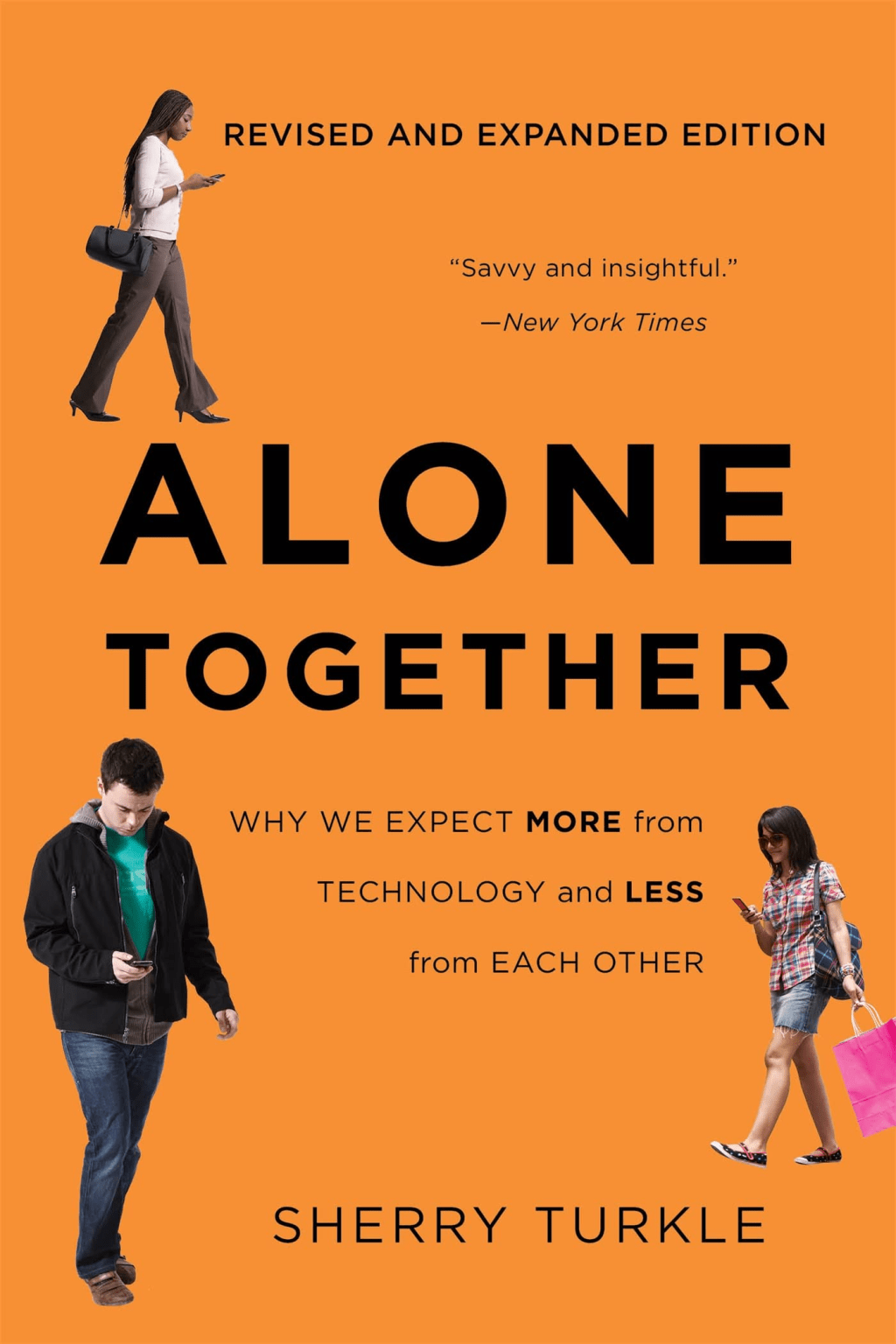
Sherry Turkle is a professor of the Social Studies of Science and Technology in the Program – Science, Technology, and Society at MIT, and is the founding director of the MIT Initiative on Technology and Self. She usually conducts qualitative research on the subjective side of human interaction with the technology, especially computers, internet and sociable robots. In today’s post I would like to discuss one of her books in short, giving an idea of the extensive work she has done in the field of social interactions involving technology.
Alone Together : Why We Expect More From Technology and Less From Each Other
This book, Alone Together by Sherry Turkle is based on the groundbreaking research on how our increasing dependence on the technology affects our relationships with fellow human beings. In this age of computers, laptops, mobile phones and tablets; we rarely leave our homes without any electronic device. Coupled with internet (which provides the ability to connect online with anyone, anywhere in the world, at any given time), these devices allow us to complete many of the daily tasks that need social interactions. From wishing our best friend on her/his birthday to trying on dresses in the virtual space, everything can be done online, without the need to actually go out and connect in the real, physical world.
Turkle has based her research on the ethnographic study she conducted through numerous interviews and observations. She has focused more on the children and young adults (between the age of 5-20), who she calls “The Digital Natives”, and has noted that her research mainly concerns those who have regular access to technology.
Part I
The book is divided into two parts – “The Robotic Moment” and “Networked”. In the first part, Turkle has discussed the increasing dependence of people on sociable robots to fulfil their basic emotional and interpersonal needs. Social or Sociable robots are the type of robots which can interact with people. They can communicate both verbally and non-verbally and can exhibit human characteristics.
The world’s first social robot KISMET was created in 1990s at MIT Media Lab. It was a robot developed to give response to the emotions of the users, had ability to recognize and analyze emotions and was able to express itself through facial expressions. In 2014, SoftBank introduced humanoid robot Pepper which became one of the most widely distributed commercial social robots. Pepper is equipped with facial recognition capabilities to read emotions and engage in interactions. It can perform various tasks and provide information through direct interaction via a touchscreen.
Other social robots produced specifically for children were Furbies and Tamagotchis which demanded care and love from the users. The children found companionship in such robotic toys that seemed to imitate and project human emotions. Paro, another social robot is a baby harp seal designed as a therapeutic tool for use in hospitals and nursing homes. The robot is programmed to cry for attention and responds to its name. It is used in elderly homes too for giving company and for providing comfort to the old people.
The invention and development of ChatBots like ChatGPT, Alexa, Siri, etc. has further complicated the scenario of human interactions with robots. Turkle points out the danger in substituting real relationships with the robotic interactions, which could lead to serious estrangement from the reality. Using technological relationships to avoid the “messiness” of actual human relationships will always result in more turbulent social interactions.
Part II
The second part of Turkle’s book – Networked – has explored the effects of living a double life. Youngsters and even adults these days, lead two lives – a real, physical life and a virtual life. The virtual life is created by maintaining a particular identity and an image, constructed through profiles, avatars and expressed though status, posts, updates, etc. It is possible that these two “lives” do not coincide with each other. This can lead to stress and pressure of maintaining the two different lives simultaneously.
Another important aspect put forth by Turkle is that people seem to be enamored by the duality of engaging in virtual relationships. Such connections and interactions provide a sense of intimacy that people need, while keeping the partners of the intimacy at a distance with the walls of virtual world. Online social platforms are a space for engaging in a perfect blend of being connected without the burden of maintaining the relationships in real world.
Even though Turkle explores the unique yet damaging dimensions of human-technology relationship, she does not advocate that we stop using technology. She critiques our excessive and obsessive dependence on technology to fulfill social and emotional needs instead of enjoying real time, physical human interactions. Through her phenomenal book Alone Together, Turkle calls for a decisive action, a request to think critically about our relationship with technology, its importance in our life and the influence it has on our perception of reality, human connection and intimacy.
The book is not aimed at giving a positive and comprehensive solution to this issue; rather it makes the readers question their ability to form genuine and real human relationships and maintain them positively.
What are your thought on this? How do you balance between real and reel relationships? How has the robotic intimacy impacted your physical reality?

Please share your thoughts!