Embalming is an art or a refined technique whereby a dead body is preserved from the process of natural decay. As we all know, a dead body, after 2-3 days, starts decomposing. It involves a set of intricate tools and methods that are performed on the dead body to give it the most natural appearance possible. Undoubtedly, Embalming is an intriguing profession for a person to adopt.
History
The roots of Embalming can be roughly traced back to the ancient Egypt, where dead bodies were “mummified”. The basis for this custom was the religious notions of immortality and physical resurrection after death. Various important people in the Egyptian history are mummified and preserved to remember their importance and contribution in the history of the country, culture and their heritage.
Archaeologists have found evidence of a high degree of embalming skill in the burial chambers of the prehistoric Paraca Indians of Peru. Ancient Babylonians, Sumerians and Greeks have been found to have embalming skills, though superficial. In the western religions such as Christianity and Judaism, there are evidences against the embalming process.
During the Middle Ages and the Renaissance Period, some important people were embalmed, including some kings, popes, scientists and artists. Some experiments were conducted during this period, regarding the traditional methods of embalming, materials used in the process and the aftereffects of those materials. In the 18th century, the technique of embalming by arterial injection became famous. This method was initially developed by a English physiologist in the first half of the 17th century.
The Dutch and Germans are believed to have developed similar technique of embalming during that time period. Gradually, the demand of embalming the dead bodies grew in Europe, especially England as well as the United States. This led to the establishment of primitive undertaking businesses and other related services that are now generally offered to the dead.
The U.S. Civil War was the turning point in breaking down public resistance to “mutilating” the body and in establishing arterial embalming as a common practice in the United States. Although the government had established national cemeteries for the war dead, it freely awarded contracts to undertakers and embalmers to prepare the bodies of soldiers for shipment to their respective homes. The widespread use of this service by soldiers’ families and the embalming of such notable dead as President Abraham Lincoln’s son Willie and later of Lincoln himself brought about increased acceptance of the profession and even caused it to become associated with patriotic activity.
Ultimately, what fixed the position of Embalming in the “services to the dead” was the introduction of its academic course in the local universities. Students could now willingly learn the scientific methods of embalming and help the dead people to get the service they would have want. Though, still a profession that was frowned upon, Embalming gained some sort of acceptance the societies in the Western and European countries.
Reasons
One of the most common reasons is the desire to preserve the body to allow for one last open-casket public viewing opportunity. This viewing may occur several days or even weeks after the actual passing of the person, as family members from distant locations travel to pay respects and collectively grieve. Without embalming or restorative preparation, natural post-mortem changes would render the body unsuitable for public display in relatively short order. Facial features sink as fluids redistribute, skin becomes discolored, and decay rapidly sets in. It can be incredibly traumatic to witness. Appropriate embalming preserves an acceptable lifelike appearance that brings a more peaceful closure.
Similarly, embalming the deceased can alleviate the heartbreaking time pressures that compound grief. Family members need reasonable time to be notified, process the news, make travel plans, and emotionally prepare to say goodbye. Making hasty arrangements due to body decomposition constraints can add even more distress. Knowing their loved one’s are preserved for services later, brings relief. Also, embalming allows transport of the deceased if the location of death is distant from the place of formal funeral services or final resting burial. Proper preservation and refrigeration allow for bringing the remains safely to a new destination.
Though we usually see embalming as connected particularly to the rituals after death or one of the processes performed in the services provided for the dead; embalming has long been considered important in the field of medical research. Anatomy and physiology students need cadavers or dead bodies to study the biological processes in human beings along with the techniques used in detection of crime. Thus, embalming has always been considered as a major tool in preserving dead bodies for medical studies.
Embalming can also be done due to legal obligations. In cases of crime investigation which may require the law enforcement agencies to preserve the dead body, embalming is considered a good option, as it reduces the rate of decomposition and the process of natural decay. Thus, it plays a crucial role in preserving the evidence of the crime.
A socio-cultural and philosophical for embalming can be to “conquer” death by deliberately defying the natural system of decomposition. Human civilizations across the globe have been interpreting death and related phenomena through various perspectives. One of them, might to be deny the fact that death can bring decay to the human body and destroy the physical beauty of living things. Thus, embalming can act as the rebellion against the radical destruction of humans occurred by death.
Methods
1. Arterial Embalming
- Process: Involves injecting embalming fluid into the body’s blood vessels, typically through the carotid artery.
- Purpose: To preserve the body by replacing blood with embalming fluid, which contains preservatives and disinfectants.
- Example: Arterial embalming is the primary method used to preserve the body’s tissues and organs.
2. Cavity Embalming
- Process: Involves aspirating (removing) internal fluids from the chest and abdominal cavities and then injecting embalming fluid into those cavities.
- Purpose: To sanitize and preserve the internal organs and tissues.
- Example: Cavity embalming is often used in conjunction with arterial embalming to ensure a thorough preservation of the body.
3. Hypodermic Embalming
- Process: Involves injecting embalming fluid directly into tissues using a hypodermic needle and syringe.
- Purpose: To treat specific areas or regions that may not have been adequately reached during arterial embalming.
- Example: Hypodermic embalming might be used to address areas of discoloration or swelling.
4. Surface Embalming
- Process: Involves applying embalming chemicals directly to the skin’s surface to preserve and restore areas that may be damaged or affected by decomposition.
- Purpose: To address areas of damage, such as from accidents or decomposition.
- Example: Surface embalming can be used to treat areas of skin damage, such as burns or cuts.
Process
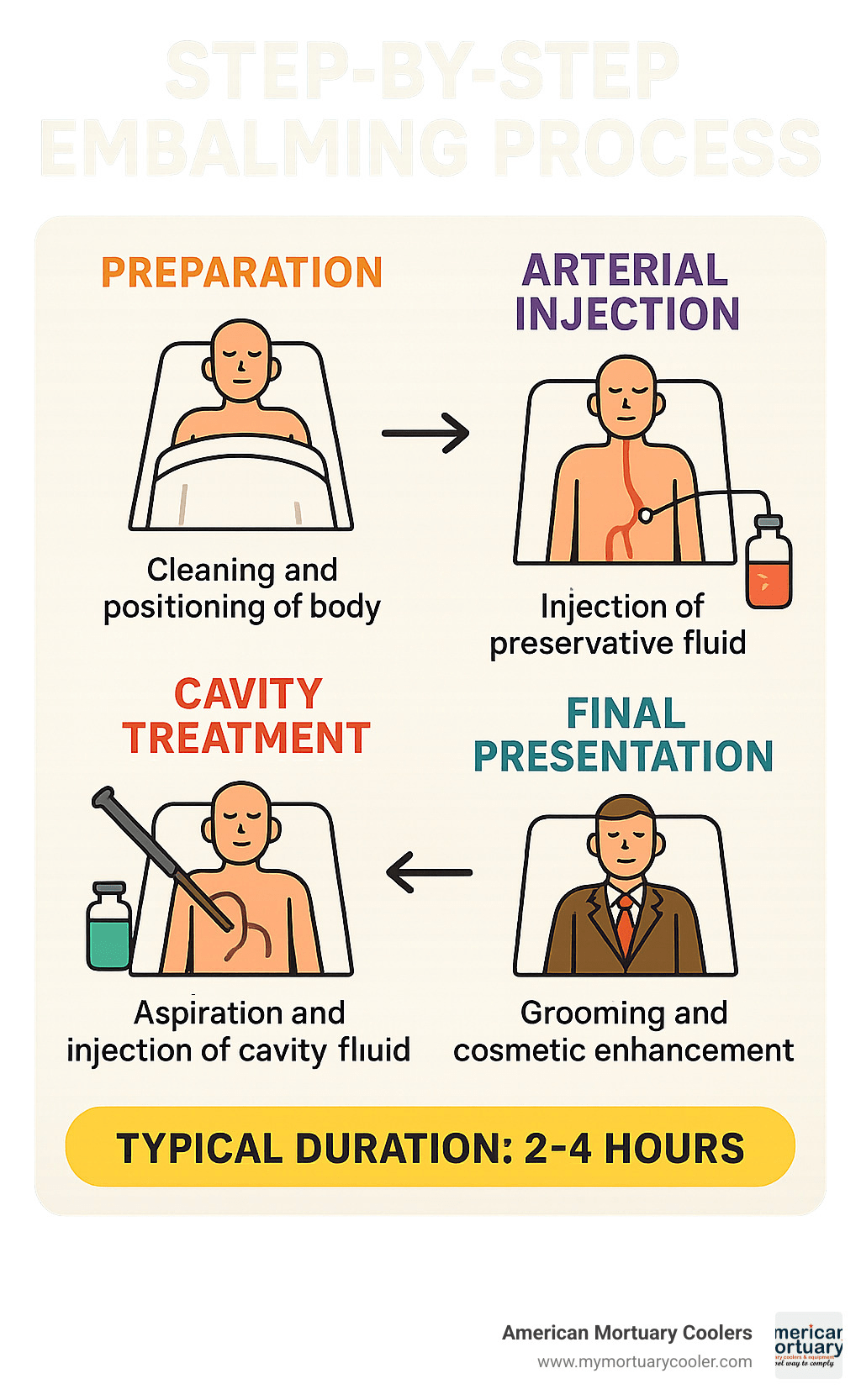
Modern embalming generally involves several key steps: Verifying death, Preparing the body, Arterial Embalming, Cavity Embalming, and Final Preparation.
1. Verifying Death: This involves confirming the absence of vital signs, ensuring the body is no longer alive.
2. Preparing the Body: This includes washing and cleaning the body, reliving rigor mortis through massage and manipulation, and setting facial features (eyes, lips, etc.).
3. Arterial Embalming: This is the process of replacing blood in the arteries with embalming fluid. This is typically done by injecting the fluid into the main arteries, while simultaneously draining the blood from the veins. The embalming fluid, often containing formaldehyde, disinfects and slows decomposition.
4. Cavity Embalming: This involves removing fluids and gases from the body cavities (chest and abdomen) using a trocar. The cavities are then filled with a concentrated embalming fluid.
5. Final Preparation: This includes washing and dressing the body, applying cosmetics, and preparing it for visitation or service.
Parting Thoughts
Though Embalming is still not considered to be a profession that any person would willing get into, it is indeed an important branch of science and restorative services. Whether it is serving the dead or helping the aspiring medical professionals or preserving the evidence of the crimes, the profession of Embalming is definitely a curious field of research.
The socio-cultural and religios implications of embalming make this field even more intriguing to analyze and study. The psychological impact of embalming can bring comfort not only for the family members but also for the larger society by being able to showcase the reversal on bodily decomposition and other elements.
I hope that the readers of this post gained something from this cursory look at one of the most undervalued professions.
What are your thoughts on this interesting yet underappreciated profession? Do you know anyone who is associated with this type of business? Or are you yourself an Embalmer? What are your experiences in this field?

Please share your thoughts!