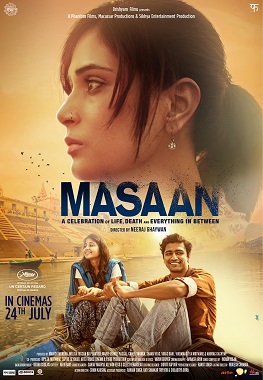
One of my good friends recently wrote a review of Massan and naturally it sparked my creative juices. This write-up is my reflection on the movie.
One if the central themes of the movie is “moving on”. Both the central characters have been through the trauma of losing someone close to them. Their desire to move on carries the second half of the film.
Moving on is a tricky thing though; to both understand and implement. I personally visualize it as “taking a heavy bag off your shoulders”. The bag contains several rocks (memories). When we decide to move on, from something or someone we take some bags from the bag and throw them away.
In that sense, it is not possible to move ahead completely. Because even if some rocks are no more in the bag, other are still there. The only way to take the entire bag off your shoulders is to die.
And even the rocks which we throw away are not the whole process of moving on. Because the feeling still lingers. The loss of weight still reminds us of the fact that something was there before. Something that was recently thrown away.
Then perhaps, moving on means getting used to the rocks when they were still inside the bag, and then getting used the empty feeling when we throw them away. Perhaps it means carrying on with the bag, adding and losing different rocks through the entirety of our life.
These thoughts direct me to “closure”. Usually it is considered as an important step in the process of moving on. But is it really? Does closure guarantee that moving on would be easier, comparatively? Or is it sometimes better to move on without closure? Maybe it depends on the person and the situation they find themselves in.
Another important theme discussed in the movie is “death”. I have always felt that death is misunderstood and misinterpreted. Mostly, there are two main perspectives we see when it comes to “dealing” with death – One treats it as a taboo, a hush-hush affair; while other treats it as something spiritual or religious and sacred.
Both these extremes fail to normalize death. They fail to recognize and accept the “beauty of death”.
I personally look as death as a goal, purpose and a destination. Death, for me, is not the end of life but a part of it. Death makes life whole, complete.
Borrowing the concepts from thermodynamics, can it be said that death is the balance we need? That the of “living” is in fact the process of “entropy? and thus, “death” is the “negentropy” we seek?
Can death be the final and ultimate truth; the only inevitable and predictable variable we can find in the chaos and disorder living entails?

Please share your thoughts!